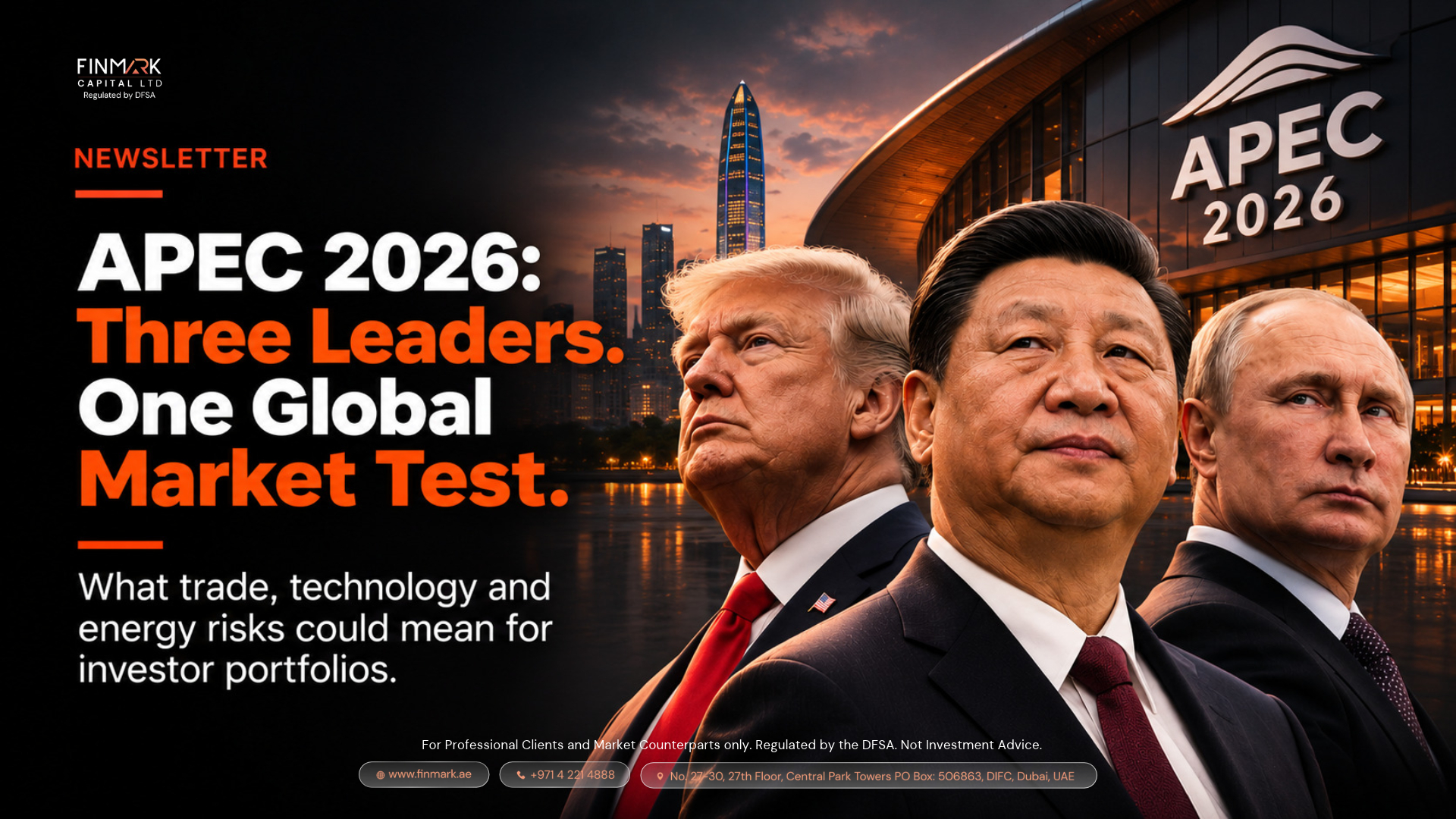
APEC 2026: Three Leaders, One Global Market Test
What you'll learn | Why it matters to your portfolio |
01. The geopolitical stakes: What the meeting between Trump, Xi and Putin could mean for international relations. | Changes in geopolitical risk could influence equities, currencies and investor sentiment. |
02. Trade and technology: Why tariffs, rare earths and AI remain central economic concerns. | Technology valuations, manufacturing costs and emerging-market exposures could be affected. |
03. The energy outlook: How regional conflicts and supply-chain disruptions could influence global markets. | Oil prices, inflation expectations and bond yields could create different risks across portfolios. |
The key takeaway: Investors should pay attention not simply to diplomatic announcements, but to whether the summit produces meaningful changes in trade policy, technology restrictions and geopolitical risk.
A meeting with consequences beyond diplomacy
The Asia-Pacific Economic Cooperation (APEC) summit will take place in Shenzhen, China, on 18–19 November, bringing together leaders from some of the world's largest economies.
Established to promote economic cooperation, APEC represents approximately 62% of global GDP and roughly half of international trade.
This year's meeting carries additional significance.
China has confirmed that Presidents Donald Trump, Xi Jinping and Vladimir Putin will meet on 19 November, creating an opportunity for direct discussions among three major geopolitical powers.
Although the planned talks include strategic stability and nuclear security, investors will also be watching for developments affecting trade, technology and energy markets.
The distinction is important: APEC operates through voluntary, non-binding commitments. A diplomatic statement does not necessarily translate into immediate changes in economic policy.
Three issues markets will be watching
01 | US-China trade and supply chains
Trade tensions between Washington and Beijing remain a major source of uncertainty.
Tariffs, access to rare earth materials and restrictions on advanced technologies continue to influence the global manufacturing landscape.
Any credible progress towards more predictable trade conditions could improve business confidence. Conversely, further restrictions could increase operating costs and complicate investment decisions.
For investors, semiconductor companies, industrial manufacturers and internationally diversified equity funds are particularly relevant areas to monitor.
02 | Technology and the future of AI
Shenzhen is home to major technology businesses, including Huawei, Tencent and BYD, making it a particularly significant setting for discussions about technological competition.
AI development increasingly depends on advanced semiconductors, computing infrastructure and internationally connected supply chains.
Changes in export controls or technology cooperation could influence the growth outlook and valuations of businesses across the AI ecosystem.
However, diplomatic engagement should not automatically be interpreted as a relaxation of existing restrictions.
03 | Energy security and geopolitical risk
The economic consequences of instability in the Middle East and the war in Ukraine remain important considerations.
Disruptions to energy supply and shipping can affect oil prices, transportation costs and inflation expectations.
For Gulf investors, changes in energy-market conditions may have contrasting effects: higher prices can support hydrocarbon-related revenues while increasing costs for airlines, logistics businesses and other energy-intensive sectors.
What should investors keep in mind?
Rather than assuming the summit will deliver a particular outcome, investors can assess several potential developments.
Improving relations: More predictable trade arrangements and reduced geopolitical uncertainty could support business confidence and selected risk assets.
Continued disagreement: Limited policy progress could leave existing tariff, supply-chain and financing risks largely unchanged.
Renewed tensions: Additional trade restrictions or regional instability could increase volatility across commodities, currencies and international equities.
The implications will differ by asset class, geographic exposure and investment horizon.
The FinMark perspective
The significance of APEC 2026 extends beyond the meeting of three global leaders.
It highlights how trade policy, technology competition and geopolitical stability have become increasingly interconnected with investment performance.
For professional investors, the priority is to distinguish between diplomatic announcements and developments that materially change corporate earnings, financing conditions or economic expectations.
The question is not whether the summit produces a historic headline, but whether its outcomes change the risks and opportunities facing global investment portfolios.
Disclaimer: For Professional Clients and Market Counterparts only. Regulated by the DFSA. Not Investment Advice.